Case studies
Case Study: Multigenerational Trauma in Family Therapy
Note
Quick answer
Presenting problem
Maria (32) sought therapy for anxiety and relationship difficulties. She reported feeling “unable to trust” partners and experiencing panic attacks in intimate situations. Initial sessions focused on her current relationships, but progress was limited until we began exploring family patterns.
The initial genogram
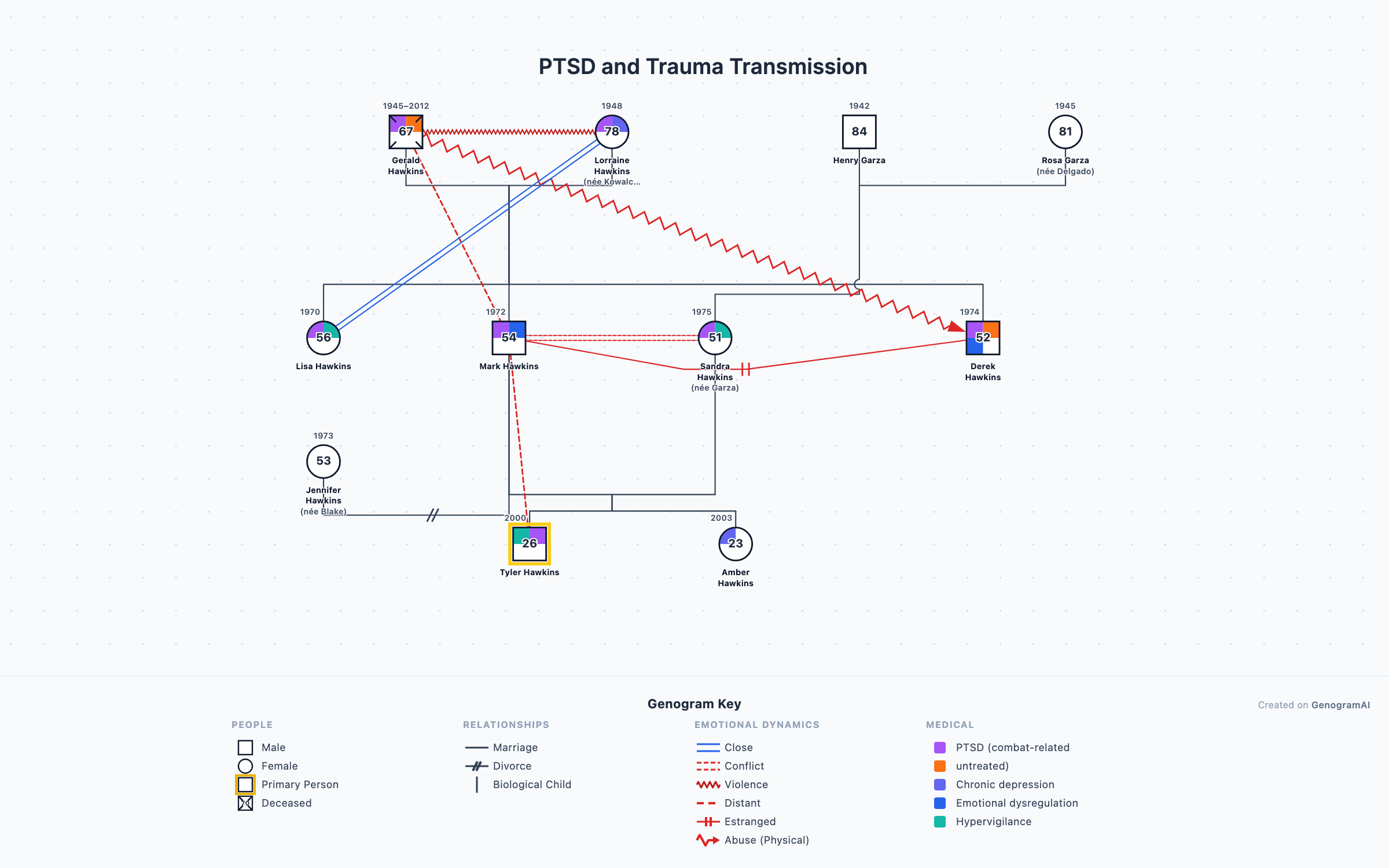
During the third session, I introduced GenogramAI to map Maria’s family structure. The initial genogram revealed basic family composition: Maria’s parents divorced when she was 8, her mother remarried, and her father remained single. She had one half-brother from her mother’s second marriage.
Uncovering patterns
Observed patterns
- Three generations of domestic violence (paternal line)
- Divorce at similar ages across generations
- Emotional cutoffs following relationship conflicts
- Anxiety disorders in women across the maternal line
- A pattern of “parentified” eldest daughters
Emotional relationship lines mapped
- Conflict between Maria and her father
- Enmeshed (fused) dynamics with her mother
- Cutoff from paternal grandparents after the divorce
- Distant relationship with her half-brother
The breakthrough moment
When Maria saw the complete genogram with emotional lines, she made a spontaneous connection: “It’s not just my father. It’s been happening forever.” This external representation let her see her struggles as part of a larger family pattern rather than personal failure.
Therapeutic interventions
- 1
Psychoeducation
About intergenerational trauma transmission. - 2
Narrative work
Examining family stories about relationships. - 3
Boundary development
To address enmeshment with her mother. - 4
Reconnection
With her paternal grandmother, cautiously. - 5
Pattern interruption
In her current relationship.
| Sessions | Genogram update |
|---|---|
| 3–6 | Structure and emotional mapping |
| 7–10 | Added medical history (anxiety patterns) |
| 11–14 | Tracked changes in current relationships |
| 15–16 | Documented improved connections |
Outcomes
Therapeutic gains
- Fewer and less intense panic attacks
- Maintained her current relationship through a difficult period
- Established contact with her paternal grandmother
- Set appropriate boundaries with her mother
- Developed language for discussing family patterns with her partner
- Expressed commitment to “breaking the cycle”
GenogramAI features used
- Emotional relationship lines made relationship patterns visible
- Medical view tracked anxiety across generations
- Quick edits kept the genogram current session to session
- Export gave the client a copy for reflection
- The AI assistant added new discoveries quickly
Clinical reflections
- Visual representation matters. Maria understood intellectually that trauma could be passed down, but seeing the pattern created emotional impact that verbal discussion couldn’t achieve.
- Genograms are living documents. Updating the genogram across sessions allowed us to track progress and reinforce change.
- Technology supports but doesn’t replace clinical skill. GenogramAI made documentation easier, but the therapeutic relationship and clinical judgment remained central to treatment.
- Pattern recognition enables intervention. Identifying the multigenerational pattern suggested specific interventions that generic anxiety treatment might have missed.
Conclusion
Multigenerational trauma often hides in plain sight: in family stories, repeated patterns and unexplained symptoms. Digital genogram tools help clinicians and clients see these patterns clearly, enabling more targeted interventions. Maria’s composite case shows how family systems thinking and modern tools can work together.
Frequently asked questions
How does a genogram show multigenerational trauma?
By laying three or more generations side by side, a genogram makes repeated events visible: violence on one line, divorces at similar ages, cutoffs after conflict, anxiety clustering among women on one side, parentified eldest daughters. Emotional relationship lines and medical shading add the relational and health layers that a family tree leaves out.
Is this case study about a real client?
No. It is a composite based on common clinical patterns; names and identifying details are invented to protect confidentiality. It illustrates a method, not a measured treatment outcome.
How often should a trauma genogram be updated?
Treat it as a living document. In this composite case the genogram was built in sessions 3 to 6, medical history was added in sessions 7 to 10, and changes in current relationships were recorded through the end of treatment.
Further reading
- van der Kolk, B. The Body Keeps the Score: Brain, Mind, and Body in the Healing of Trauma. Viking, 2014.
- Yehuda, R., & Lehrner, A. Intergenerational transmission of trauma effects: putative role of epigenetic mechanisms. World Psychiatry, 17(3), 243–257, 2018.
- McGoldrick, M., Gerson, R., & Petry, S. Genograms: Assessment and Treatment (4th ed.). W.W. Norton & Company, 2020.
- Bowen, M. Family Therapy in Clinical Practice. Jason Aronson, 1978.
GenogramAI is designed for educational and personal use. It is not a medical device and should not be used for clinical diagnosis or treatment decisions.